
Edmund tucked his graying locks into his helmet and tightened the strap. He pedaled with caution, but the bicycle wobbled from the weight of the bulging duffels. Under a weave of bungie cords, the bag in the basket swayed, top-heavy. The other two dangled from the grip-ends of the handlebars. He was turning at the corner of Magenta when he heard the rub of rip-stop on tire. To free the bag from getting pulled under the fender, he adjusted the arc of his trajectory and found himself in the middle of the street. As cars honked from behind, he worked his way back to the bike lane. Four blocks to go. The trip was the first of an impossible iceberg.
The light was green at the next intersection. Edmund ignored the ache of his le knee and accelerated hoping to cross before the light yellowed. He wished to avoid any necessary stops, but two women entered the crosswalk: the first, pushed a stroller; the second was pulled by a Corgi on the full length of extendable leash. He ran his bell. The clapper thumped mutely under the bulge of the duffel. He sighed, braked and felt a pulse of panic as he slid from the seat, settling one worried foot after another on the pavement. The dog, infant, and blithe mother filed past him; the light turned red. He could still turn left at Beaumarché and circle back.
“That’s quite a load,” exclaimed the tail-end of the leash.
“Just a few things for the Salvation Army,” Edmund responded, his annoyance disarmed by the color of her eyes. The shape, too, reminded him of his upstairs neighbor. The one he liked watching, as the sway of her hips disappeared up the carpeted steps.
Impatient, he stifled a desire to pat the contents in the basket. He tried not to think of Jacqueline, on the cover of the National Geographic with her pill box hat and red roses, that his dear Josette had so admired. He hated the idea of crisp corners becoming dog-eared. He pushed aside, too, his fondness for one of the Kipper ties nestling in the bag on the right; the dapper shade of olive-green from which teal paisleys murmured brightly. All that elegant silk, but no one wore wide es anymore – no one wore ties anymore. The flannel bathrobes, the slippers and the tea towels with the embroidered edges had been easier to pack.
He urged the light to turn green, wished the bags gone – and all the boxes too. How many trips before he could invite the new neighbor to tea? He closed his eyes as if to shut out the idea that he should turn around, bring the belongings home.
“Hey my friend, dreaming on a bicycle could be hazardous.” Edmund opened his eyes to a grin with gaps. It belonged to a man that looked his age, but Edmund guessed was younger. The man had sidled up closer than Edmund considered polite. Straddling the heavy bicycle, he felt trapped, checked the still-red light.
“You headed to the Army Thrift?” the grinning man asked.
Edmund’s throat was too tight to release words; he managed a nod.
“Any men’s wear?” “Mostly m-magazines,” he replied. Ties would not be helpful, and Josette’s mother’s things even less. As the car beside him started moving, he felt relief and apologized to the man as he lifted one foot to a raised pedal. “I need to concentrate.” He shifted his weight and felt himself roll forward. His coccyx bumped on the padded point of the seat before he raised himself up sufficiently. The odor of the man’s beery breath lingered as he began peddling. He had timed the trip to arrive at the Thrift before it opened; unlike the man, he did not feel comfortable approaching or speaking to strangers. When he had packed the first bag, he hadn’t known that about himself. He thought about how Josette, after 9/11, had stopped wanting to travel; how with Charlie Hebdo and the Bataclan her fear had increased. Even before Covid, they had begun their own confinement. That was before it took her away.
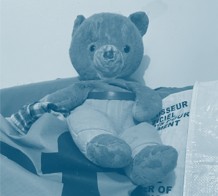
Ahead, mid-block, a few bundles were already waiting near the half-raised metal curtain. His legs soldiered on. The right one taking up the slack for the achy left. With the contents of the bags gone, the door to the burlwood cabinet would be more accessible. He pictured himself that evening sipping sherry from one of their wedding gifts – a cut-glass cordial. But instead, the image of a stuffed bear atop a shopping cart arose; its marble eyes watching its owner with the missing teeth.
And Edmund wondered about the pull of objects, about how the man had held his beer upright behind his back. As though, out on the city corner, he could hide the part of himself that needed to cling to that canister, the same part that had placed on the prow of his possessions a soft sewn symbol of comfort. Was it the objects, or the hope they inspired that held him up, propelled him forward, like Edmund now?
Readying himself for the awkwardness of stopping, he squeezed the brakes several meters in advance. As his body swung forward, suspended between the safety of the seat and the ground below, he saw how the past had sidled up to his present. And how, in clinging to the clutter of the life he once had, he had almost lost its savor. As his feet regained the firmness of the street, he imagined packing a new bag to bring along with the next load: a few flannel shirts, some unneeded boxers, socks, a scarf.
From a collection written in 2022.
Published in The End of the World june 2025.