
Outside the bus window, a brush moved up and down scrubbing angrily at graffiti on a long mustard wall. Under numbered poles, passengers shifted through the postures of waiting. Inside, the warm air trickled to a stop. The bus driver held his cap and watched while, still groggy and puzzled, Sister Marguerite put on her coat and shouldered her satchel; the thick tangle of his eyebrows was all that was left of the rural wilderness through which they had passed. Sister Marguerite, however, could still see the dark roots of the lion’s whiskers and his feathery mane, the same white gold as the rain-laden pond plumes.
She took the steep metal steps cautiously. Outside, the cold air was grubby with exhaust. She joined the stream of passengers exiting another bus. The train station was across an empty parking lot. The path they followed was striped with new white bands over old asphalt. A woman several steps before her pulled a shopping trolley. One of its wheels was jammed and left a thin trail of shredded plastic. On the screen in the hall, the train times shifted upwards. Her train would arrive at quai D. In the underpass she watched the trolley bag turn and thump up steps to another quai. Her mind skipped ahead. She should write a thank you note to Mother Edwina and mention the trip to Prague. She wove a path through the throng, found the stairs up to her train, walked onwards searching for an opening. Why go to Prague—had she become someone who avoided problems?
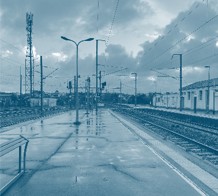
She walked to the tail end of the quai past the tapering crowd. A river of tracks separated the platform from a distant bank where overgrowth invaded forgotten walls. The emptiness soothed her, like the space of the church before mass or the dojo after training; the vastness offering up a sense of options, like a blank page, the giddiness of choice. Is that what she wanted—her own new page? She turned, felt an inner trembling. At the end of the converging rails, she could see it under the overcast sky, a grey-blue rectangle. Her train was arriving. She needed to hurry. She turned her back to its growing form and walked towards the huddle of humans busy gathering up bags and strollers. The train caught up with her halfway, where she had stopped to watch as a cello stood itself upright and pivoted like a dancer, before lining up in the queue.
She climbed into the last wagon and caught her breath in the vestibule as the doors slid shut behind her. She had a long hour of travel time. In the compartment, the window seats were all occupied. She studied the passengers occupying the hard plastic shells of the inter-regional train before sitting down opposite a man absorbed by an open book. Her satchel lay heavy in her lap. From it she took her phone, intending to write the thank-you message to Mother Edwina; but instead, she opened the Notes App where she had begun the text for the Kiranbo.
As she resumed writing, Sister Marguerite didn’t notice the man in front of her cross his legs while he turned a page; he didn’t lift his head and see her two thumbs pecking, halting, thinking, fluttering above the smooth blue light of the screen. He didn’t notice how often she began anew, how at last she forged one complete phrase and, without stopping, began another. How, adjusting, forever seeking, refining words and meaning, she slipped away from the space of the train.
So, when the book in front of her was closed and lifted away, she didn’t see how the man slipped out sideways to avoid disturbing her, how the stop was the stop before hers, before the end of the line. The man did, as he walked along outside of the train, stop to look back in at her through the unwashed window, there still intent on her text, her thumbs moving rhythmically as if working through a rosary.
Draft for dojo website
I had many preconceived notions about martial arts: sweat, virility, violence… A space limited to the ego. But each of these has been undone by what I found, and keep finding, at the Kiranbo Dojo: new notions of ritual, persistence, questing, an intriguing mixture of rigor and invention, of remaining present with oneself and with the other. The dojo isn’t mystical and abstract, but built of human beings at their best, or at least trying to be their best, giving their selves, mentally, physically.
The practice itself is visceral, intense, practical because technical, but also surprisingly spiritual. Training makes me a better person and so I keep returning…
Fragment n° 39 from a novel in progress about Sister Marguerite a faithless nun. Working title: Noguru.